Imagine releasing a song and getting paid instantly, every single time someone streams it. No waiting six to eighteen months for royalty checks. No mysterious fees vanishing into the pockets of middlemen. This is the promise behind Streaming Rights as NFTs, a system that uses blockchain technology to tokenize access to content and automate payments directly to creators. It sounds like a dream for artists tired of the traditional industry’s slow payout cycles, but does it actually work in practice?
The concept isn't just hype; it's a functional shift in how we think about digital ownership. Instead of buying a track on iTunes or streaming it on Spotify where you rent access, an NFT represents a verifiable deed to specific usage rights. You aren't just listening; you are holding a piece of the economic value attached to that stream. But before you rush to mint your first token, there are serious technical hurdles, legal gray areas, and user experience issues that need unpacking.
How Streaming Rights NFTs Actually Work
To understand why this matters, you have to look at what happens under the hood. In the traditional model, when you stream a song on Spotify, the platform tracks that play, aggregates millions of data points, and then sends reports to collection societies. Those societies calculate splits based on complex contracts, deduct their fees, and finally cut checks. It is a broken pipeline that often leaves independent artists starving while labels thrive.
NFT-based systems flip this script using Smart Contracts. These are self-executing codes stored on a blockchain like Ethereum. When a creator mints an NFT with embedded streaming rights, they can code the royalty split directly into the token. If the NFT grants permission to stream a track, the smart contract automatically triggers a payment to the creator's wallet the moment the condition is met-or upon secondary sales if the model is based on resale royalties.
Here is the catch: the NFT itself does not store the audio file. Audio files are too large for blockchains. Instead, the NFT contains a cryptographic link (usually via IPFS, or InterPlanetary File System) pointing to where the content lives. The blockchain handles the rights management and money movement, while traditional servers handle the actual video or audio delivery. This hybrid approach is crucial because it separates ownership verification from content distribution.
The Real-World Benefits for Creators
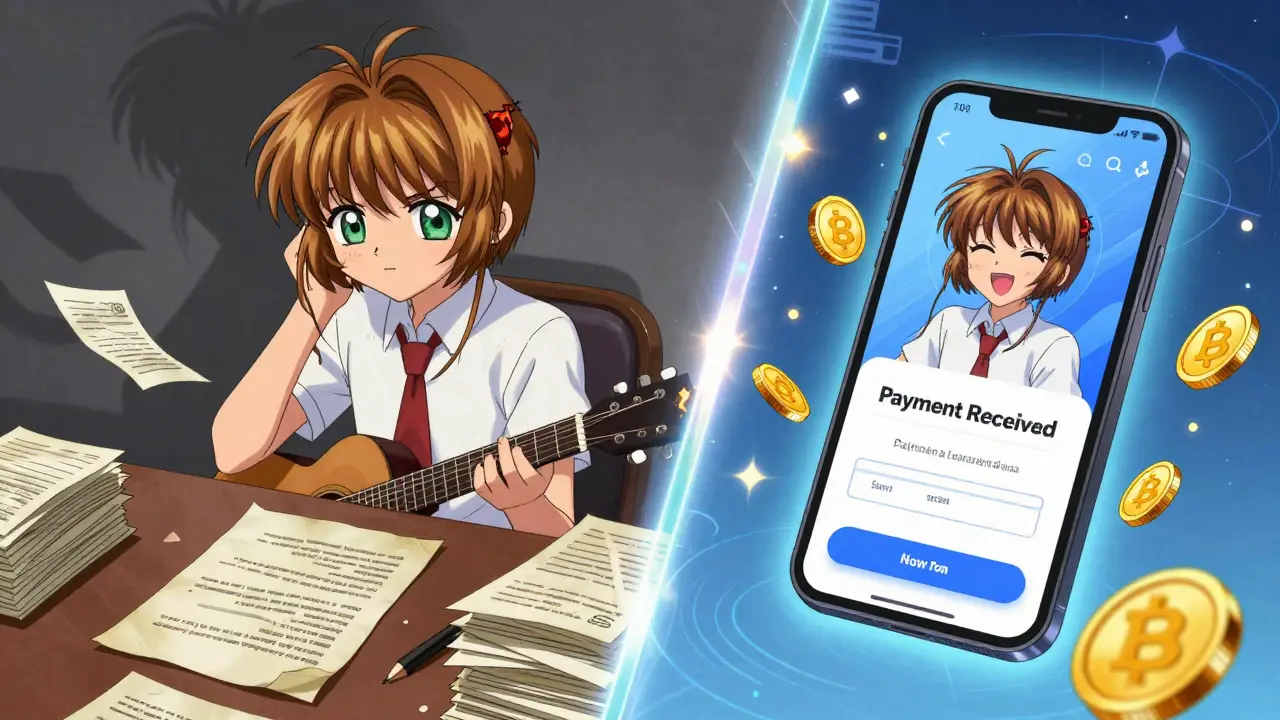
Why would an artist bother with the complexity of crypto wallets and gas fees? The answer lies in control and speed. According to data from Hyperglade (2022), traditional royalty systems require fees paid by the artist and take an unnecessarily long time to process. In contrast, NFT systems promise immediate transparency.
- Instant Payouts: Artists like 3LAU reported earning $11.7 million from NFT album sales with built-in streaming rights, bypassing traditional label delays entirely.
- Direct Fan Relationships: Fans don't just consume; they invest. Holding an NFT can grant exclusive access to live streams, unreleased demos, or community chats, creating a tighter bond than a standard subscription.
- Transparent Accounting: Every transaction is recorded on the public ledger. There are no hidden deductions or opaque algorithms deciding who gets paid what.
For niche markets-like exclusive live concert streams or limited-edition drops-this scarcity adds real value. It turns passive listeners into active stakeholders. However, this benefit is currently limited to early adopters and tech-savvy fans, not the mass market.
The Technical Hurdles You Can't Ignore
If the benefits sound great, why hasn't everyone switched yet? The technology is still immature. One major issue is "link rot." Because the NFT only points to the content, if the server hosting the audio goes down or changes its address, the NFT becomes useless. A Reddit user reported having to wait three weeks for support to fix a broken podcast link tied to their NFT. That is a terrible user experience.
Then there is the cost. On Ethereum mainnet, transaction fees (gas fees) can average over $1.27 per transaction, according to BitInfoCharts (Q2 2023). For a micro-payment streaming model, paying $1 to listen to a song makes no sense. Developers are turning to Layer 2 solutions like Polygon to reduce these costs, but that adds another layer of complexity for users who already struggle with wallet management.
Performance is another bottleneck. Blockchain transactions can take 15-30 seconds on Layer 2 networks, or up to 5 minutes on mainnet. Real-time streaming authorization requires near-instant validation. Until blockchain throughput improves significantly, integrating seamless, frictionless streaming remains a challenge.
Legal Gray Areas and Copyright Risks
This is where things get tricky. Buying an NFT does not mean you own the copyright to the underlying work. Rebecca Tushnet, a legal scholar at Harvard Law School, warns that purchasers acquire whatever the art world thinks they have acquired, which is rarely full copyright unless explicitly transferred in writing.
In March 2023, the U.S. Copyright Office issued guidance stating that NFT ownership does not convey copyright ownership without a clear written agreement. This creates a minefield for streaming rights. If an NFT grants "streaming rights," does that mean personal use? Commercial redistribution? Broadcast rights? Without standardized legal language embedded in smart contracts, disputes are inevitable. Norton Rose Fulbright notes that in the absence of an express license, implied licenses are likely narrow, potentially leaving holders with fewer rights than they expected.
Comparison: Traditional vs. NFT Streaming
| Feature | Traditional Platforms (Spotify/Apple) | NFT-Based Systems (Audius/Royal) |
|---|---|---|
| Payout Speed | 6-18 months | Immediate to 24 hours |
| Ownership Record | Centralized, opaque database | Decentralized, transparent ledger |
| User Experience | Familiar, easy access | Complex, requires wallet setup |
| Cost per Transaction | Negligible (subscription fee) | Variable gas fees ($0.01 - $2+) |
| Market Reach | Billions of users | Niche (approx. 6.5M MAU on Audius) |
Who Is Leading the Charge?
Several platforms are experimenting with this space. Audius is perhaps the most prominent music streaming platform built on blockchain, reporting around 6.5 million monthly active users in Q2 2023. They allow artists to release music and tokens simultaneously. Royal partnered with Warner Music Group to tokenize streaming rights for major artists, allowing fans to buy shares in future royalties. Meanwhile, giants like Spotify launched "Artist Fundraising Links" in September 2023, incorporating limited NFT functionality to bridge the gap between Web2 and Web3.
Despite these efforts, adoption remains low. NFT music platforms capture less than 0.1% of the $35.5 billion global music streaming market. The barrier to entry is simply too high for the average listener who just wants to hear their favorite song without managing a private key.
Is It Worth It Right Now?
For mainstream listeners, probably not. The friction of setting up wallets, buying crypto, and dealing with potential broken links outweighs the benefits. However, for dedicated fans and independent creators looking to monetize exclusivity, it offers a powerful new tool. The technology is promising but immature, rated 6.5/10 for functionality by CoinDesk (2022) due to smart contract limitations in handling complex royalty splits.
As Ethereum moves toward more scalable solutions and standards like ERC-2981 for royalties become widely adopted, the experience will smooth out. But until then, streaming rights as NFTs remain a specialized instrument for those willing to navigate the complexities of blockchain for greater financial autonomy.
Do I own the copyright when I buy a streaming rights NFT?
No, not automatically. Unless the smart contract or accompanying legal agreement explicitly transfers the copyright, you typically only receive a license to use the content for specified purposes (like personal streaming). The original creator usually retains the copyright.
Why are NFT streaming payouts faster than Spotify?
Traditional platforms rely on manual reporting and third-party collection societies that take months to process. NFTs use smart contracts that execute payments automatically on the blockchain the moment a predefined condition (like a sale or stream count) is met, removing intermediaries.
What happens if the content link breaks?
If the decentralized storage (like IPFS) fails or the pinning service stops working, the NFT may point to a dead link. This is known as "link rot." To mitigate this, reputable platforms use multiple redundant storage providers and permanent pinning services.
Are gas fees too high for streaming music?
On Ethereum mainnet, yes. Fees can exceed the value of a single stream. Most modern platforms use Layer 2 solutions like Polygon or Solana to keep transaction costs fractions of a cent, making micro-transactions viable.
Can I sell my streaming rights NFT later?
Yes, one of the key features of NFTs is transferability. You can sell them on secondary markets. Depending on how the smart contract is coded, the original creator may also earn a royalty percentage from your sale.