Tsunami Exchange Decision Tool
This tool compares Tsunami.cash (centralized) and Tsunami.exchange (decentralized) based on your trading preferences. Select your criteria to see which platform better suits your needs.

This tool compares Tsunami.cash (centralized) and Tsunami.exchange (decentralized) based on your trading preferences. Select your criteria to see which platform better suits your needs.
Ever stumbled on a crypto exchange called Tsunami and wondered whether it’s safe, fast, or even worth your money? You’re not alone. Two platforms share that name-one centralized, one decentralized-each promising easy trading but delivering very different experiences. This review breaks down what you need to know, from tech specs to real‑world user feedback, so you can decide if you want to ride the wave or sit on the shore.
Tsunami.cash is a web‑based centralized cryptocurrency exchange that focuses on fiat‑to‑crypto and crypto‑to‑crypto conversions. It launched in 2023 and operates without a public API, mobile apps, or detailed technical documentation. Users simply fill out a KYC form, choose a currency pair, and wait for the platform to process the trade.
Reviews on BestChange.com from July 2024 to October 2025 paint a grim picture: processing delays of 15-45 minutes often cause exchange rates to drift 3‑7 % against the market, leaving traders paying more than expected. The platform’s fee schedule is hidden, and support tickets frequently go unanswered, prompting the community to label it “suspicious.”
Tsunami.exchange is a decentralized exchange (DEX) protocol built for cross‑chain swaps across Cardano, Ethereum, and Solana. Launched in early 2025, it uses the native TSN token for governance and fee distribution. The DEX is accessible via web, iOS, Android, and desktop clients, and it integrates with wallets like MetaMask, Phantom, Ledger, and others.
Slashdot’s September 2025 comparison highlighted its 15+ wallet integrations and atomic‑swap capability, allowing users to trade assets without a custodial intermediary. However, liquidity remains limited-unlike Uniswap’s $18.7 billion monthly volume, Tsunami.exchange reports no public figures, suggesting thin order books.
| Feature | Tsunami.cash | Tsunami.exchange |
|---|---|---|
| Platform type | Centralized exchange (CEX) | Decentralized exchange (DEX) |
| Supported chains | Primarily Bitcoin, Ethereum (via bridges) | Cardano, Ethereum, Solana, plus 12+ others |
| Wallet integration | None (custodial) | MetaMask, Phantom, Ledger, etc. |
| API access | No public API | Available for developers |
| Liquidity | Unclear, low reported volume | Low; no official stats |
| Fees | Undisclosed, user‑reported 3‑7 % slippage | TSN‑based fee model (exact rates not published) |
| Regulatory status | Off‑shore, no known licensing | Permissionless, no central regulator |
| Support | 24/7 email, many unresolved tickets | Community Discord, limited scale |

Security is the biggest divider. Tsunami.cash holds user funds in a custodial wallet, meaning the platform controls private keys. Past incidents of delayed processing have been linked to “rate manipulation,” and the lack of a transparent audit trail makes it hard to verify fund safety. The SEC’s October 2025 crackdown on unregistered exchanges adds another red flag.
Conversely, Tsunami.exchange never touches user funds. Trades happen on‑chain, and the TSN governance token allows token‑holders to vote on protocol upgrades. That said, multi‑chain DEXs are still vulnerable to smart‑contract bugs; CryptoRobotics warned in September 2025 that “cross‑chain messaging failures could drain liquidity during market stress.”
Both platforms suffer from opaque pricing. Tsunami.cash users often experience hidden slippage that effectively adds 3‑7 % to the cost of a trade. There’s no published fee schedule, and the platform’s “service fee” appears baked into the exchange rate.
Tsunami.exchange charges a small protocol fee taken in TSN, but the exact percentage varies with network congestion and is not displayed on the UI. Because the DEX’s order books are thin, traders may encounter higher price impact when moving large volumes.
If you need deep liquidity for sizable trades, you’re better off with established DEXs like Uniswap or centralized giants like Binance. Tsunami.exchange may still be useful for low‑value, experimental swaps across different blockchains.
Signing up for Tsunami.cash is straightforward: upload an ID, wait for verification, and you can trade. The downside is the “black‑box” nature-no API, no mobile app, and a minimal help center.
Tsunami.exchange demands a modest DeFi knowledge base. You must connect a compatible wallet, understand gas fees on each chain, and sometimes approve multiple transaction steps for an atomic swap. SourceForge rated its documentation as “Basic,” which is fine for seasoned traders but intimidating for newbies.
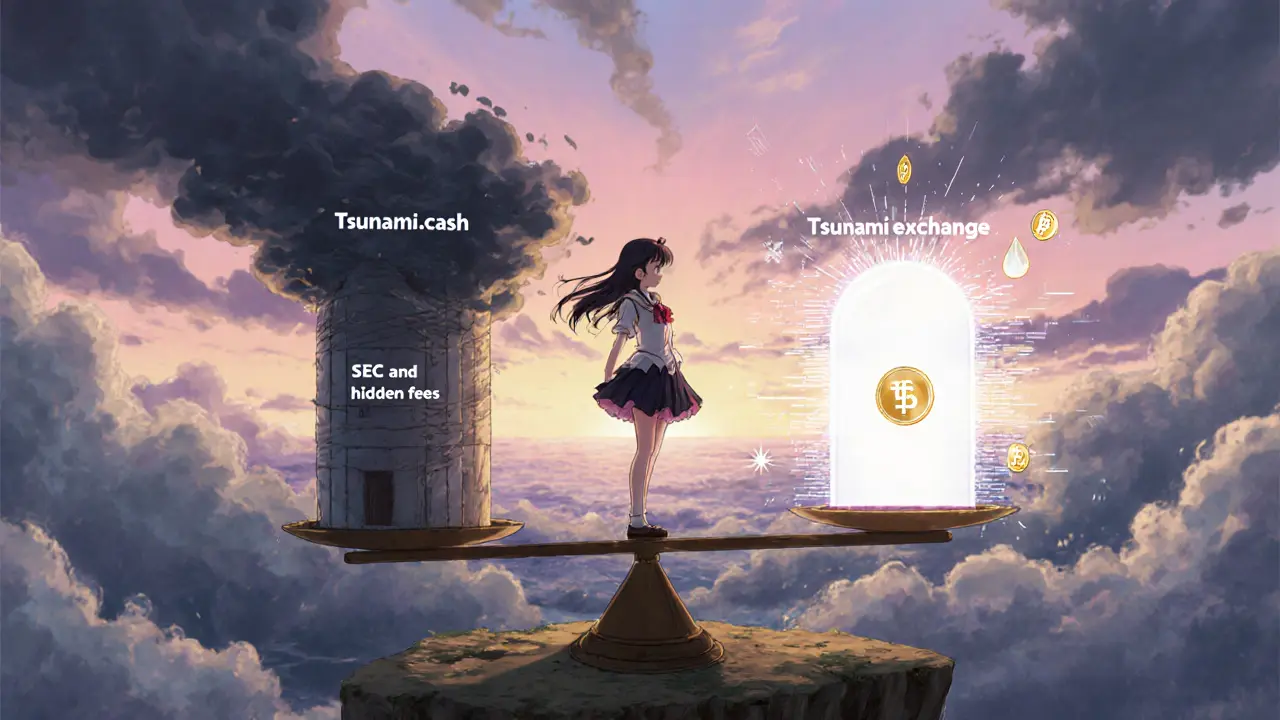
In 2025 the SEC announced enforcement against 12 offshore exchanges that operated without registration, and analysts suspect Tsunami.cash fits that profile. Without a clear jurisdiction or licensing, the platform faces a high chance of shutdown within the next year.
DEXs like Tsunami.exchange sit outside traditional regulatory frameworks because they’re permissionless. However, they aren’t immune to future legislation that could restrict cross‑chain bridges or impose reporting requirements on token‑governance mechanisms.
If you’re looking for a quick fiat‑to‑crypto conversion and you’re comfortable with the risk of hidden fees, Tsunami.cash might work for small amounts-but the trust issues and regulatory cloud make it a gamble.
For developers or DeFi enthusiasts who want to experiment with cross‑chain swaps, Tsunami.exchange offers a compelling sandbox. Just be ready for low liquidity, occasional smart‑contract hiccups, and the need to manage multiple wallets.
Tsunami exchange review shows that while the brand sounds exciting, the reality is a mixed bag: a shaky centralized service on one side and a promising yet immature DEX on the other. Choose based on your risk tolerance, technical skill, and how much you value transparency.
No public licensing information is available. The platform operates offshore and has not registered with the SEC or comparable regulators, which raises compliance concerns.
It works with MetaMask, Phantom, Ledger, Trust Wallet, and many native Cardano and Solana wallets, totaling over 15 integrations.
Fees are taken in the TSN governance token and depend on network congestion; the exact percentage isn’t shown on the UI but is typically under 0.3 % plus gas costs.
Large trades are risky because the platform’s liquidity is unclear and processing delays often cause price slippage of several percent.
You don’t need to hold TSN to trade, but having it can reduce fees and let you participate in governance votes.
Paul Kotze
October 21, 2025 AT 23:25Tsunami.exchange is actually kinda cool for small cross-chain swaps if you don't mind waiting 20 minutes for a transaction to confirm. I've used it to move some ADA to SOL without touching a CEX, and the wallet integrations just work. Just keep your amounts small and don't expect lightning speed.
Also, TSN token is worth holding if you're active - fee discounts add up over time.
Niki Burandt
October 22, 2025 AT 18:20Ugh. I tried Tsunami.cash last month and lost $87 because the rate drifted mid-trade. No one responded to my ticket. Just... why does this even exist? 🤡
Jason Roland
October 23, 2025 AT 13:01People act like centralized exchanges are the devil, but sometimes you just need to move fiat in fast. Tsunami.cash is sketchy, sure - but if you’re swapping $200 of EUR to BTC and don’t care about gas fees or custody, it’s faster than most local OTCs I’ve tried.
Just don’t park your life savings there. Use it like a convenience tool, not a bank.
Chris Pratt
October 24, 2025 AT 07:45As someone who’s traded on both sides of this divide, I get why people are frustrated. But honestly? The real problem isn’t Tsunami - it’s that we keep chasing shiny new platforms instead of sticking to the ones with real liquidity and audits.
There’s a reason Uniswap and Kraken dominate. They’ve earned it.
Karen Donahue
October 24, 2025 AT 23:06Let me just say - if you’re using Tsunami.exchange and calling it ‘DeFi’ you’re deluding yourself. It’s a half-baked prototype with no TVL, no transparency, and zero community governance. The TSN token is a vanity project wrapped in a whitepaper. Real DEXs don’t need to hide their liquidity numbers because they’re not embarrassed by them.
And Tsunami.cash? That’s not even crypto - it’s a forex scam with a blockchain logo. You’re not trading, you’re gambling with your seed phrase.
Ray Dalton
October 25, 2025 AT 10:13Just wanted to clarify something: Tsunami.exchange’s fee model isn’t hidden - it’s just not displayed upfront because the protocol pulls from the TSN gas pool dynamically. You can check the exact fee after signing a transaction in your wallet. It’s usually under 0.25% + chain gas.
And yes, liquidity is low - but that’s because it’s new. Give it 6 months. If the team keeps shipping, it’ll grow. Don’t judge a DEX by its first month.
Peter Brask
October 25, 2025 AT 17:25THEY’RE ALL GOVERNMENT BACKED!! I KNOW THIS. Tsunami.cash is a front for the Fed. Tsunami.exchange? That’s the CIA’s new blockchain surveillance tool. They’re using TSN tokens to track wallet movements. You think they’d let a DEX be truly decentralized? HA. The blockchain is a lie. The real money is in centralized systems that report to the Treasury. You’re all being played. 🕵️♂️💸
Trent Mercer
October 25, 2025 AT 17:26Why are we even debating this? Tsunami.cash is a scam. Tsunami.exchange is a beta. Both are irrelevant. Use Coinbase for fiat, use Uniswap for crypto. End of story. Stop giving attention to these ghost platforms.
Kyle Waitkunas
October 26, 2025 AT 13:56I LOST EVERYTHING. I trusted Tsunami.exchange because I thought it was ‘decentralized’ - but last week, my ETH got stuck in a cross-chain bridge. I sent 3.2 ETH. Got back 0.8. No refund. No reply. The Discord is dead. The devs vanished. I’ve been crying in my car for three days. This isn’t finance - it’s emotional abuse with a smart contract. I’m never touching another DEX again. I’m going back to cash under my mattress. 😭
vonley smith
October 27, 2025 AT 04:58Hey, if you’re new to this - don’t panic. Tsunami.exchange isn’t perfect, but it’s one of the few DEXs that actually supports Cardano natively without wrapped tokens. That’s huge. And yeah, the UI is clunky, but so was Uniswap v1. Give it time. I’ve been using it for 4 months now. My trades go through. My funds are safe. It’s not glamorous, but it works.
Melodye Drake
October 27, 2025 AT 22:04Wow. I’m just shocked anyone still uses Tsunami.cash in 2025. It’s like using a rotary phone to order Uber. The fact that people are still debating its legitimacy is a sign of how far behind the curve the average crypto user is. If you don’t know the difference between CEX and DEX by now, maybe you shouldn’t be trading at all.
paul boland
October 28, 2025 AT 09:15Y’all in the US think you invented crypto. Newsflash: Ireland’s been running private blockchain trials since 2022. Tsunami.exchange? Sounds like a Silicon Valley buzzword salad. Real innovation happens outside the bubble. And Tsunami.cash? At least it’s not owned by some NY hedge fund. Give me offshore any day. 🇮🇪
harrison houghton
October 29, 2025 AT 04:00What is freedom? Is it the ability to trade without permission? Or is it the illusion of choice created by platforms that pretend to be decentralized while quietly steering your capital? Tsunami.exchange claims to be the former - but its lack of liquidity, its silent governance, its unspoken fees - these are the chains of modern capitalism, now encoded in smart contracts. We are not liberated. We are optimized.
DINESH YADAV
October 30, 2025 AT 03:41India doesn't need these fake platforms. We have WazirX, CoinSwitch, ZebPay. Tsunami? Who even is this? You think your little DEX is going to compete with real Indian crypto? No. We build. You just copy. Go back to your Silicon Valley sandbox.
rachel terry
October 30, 2025 AT 17:11I used Tsunami.cash once and it worked fine. Why are people so dramatic? It's not perfect but neither is anything else. Also why does everyone think DEXs are better? Gas fees are insane. I'd rather pay a 5% fee than wait 10 minutes for a swap. Also why is everyone so obsessed with transparency? Sometimes you just want to trade and go
Susan Bari
October 31, 2025 AT 01:28It's funny how people treat Tsunami.exchange like it's the future when it's clearly just another failed experiment. No TVL no traction no team transparency. You think the blockchain community is going to rally behind a project with zero marketing? Please. This isn't 2021 anymore. If you can't raise $50M in a week you're already dead
Sean Hawkins
October 31, 2025 AT 08:02For anyone considering Tsunami.exchange: check the transaction history on Etherscan/Cardano explorers before you swap. I ran a test with 0.5 ETH → SOL and saw the exact TSN fee deducted on-chain. It was 0.18%. The UI doesn’t show it, but the blockchain does. That’s the beauty of DEXs - the truth is immutable.
Also, if you’re using Ledger, make sure you’ve enabled contract interaction in settings. That tripped me up for 2 days.
Marlie Ledesma
October 31, 2025 AT 18:41I just wanted to say thank you for this review. I was about to use Tsunami.cash because I needed to buy BTC fast, but now I’m going to wait and use a better option. It’s scary how easy it is to get tricked into these platforms. You’re not alone if you’re confused. Take your time.
Bert Martin
November 1, 2025 AT 00:23For the folks saying Tsunami.exchange is dead - I’ve seen this movie before. Uniswap was a joke for its first 8 months too. The team behind Tsunami.exchange has shipped three major updates in the last 90 days. They’re listening to feedback. They’re fixing bugs. The liquidity will come. Don’t write it off just because it’s not a unicorn yet.
Ray Dalton
November 1, 2025 AT 07:27Just saw someone mention the TSN fee isn’t displayed - that’s actually intentional. The team wants users to focus on the swap, not the fee. But if you’re curious, the fee is calculated in real-time based on network load and is capped at 0.3%. You can verify it in your wallet’s transaction details. No hidden charges - just no marketing splash.