
The Axioma Token (AXT) sounds like a promising crypto project: a digital asset tied to real estate, built on Binance Smart Chain, with a market cap over half a billion dollars. But look closer, and the story falls apart. AXT isn’t just another obscure token-it’s a high-risk asset with glaring red flags that raise serious questions about its legitimacy.
What Axioma Token (AXT) Claims to Be
AXT is marketed as the core utility token for the FFSRO ecosystem, a platform that promises to let everyday people invest in real estate without needing large sums of money. According to project materials, owning AXT gives you access to fractional ownership of properties, with rental income distributed to holders. It’s an appealing idea-democratizing real estate investment. But here’s the catch: there’s no public proof any of this is real.
No whitepaper exists. No team names are listed. No property portfolios are published. No legal structure is disclosed. The entire concept relies on claims, not documentation. Compare this to platforms like RealT or Brickblock, which openly list every property they tokenize, show title deeds, and provide third-party audits. AXT offers none of that.
The Price That Doesn’t Add Up
AXT’s market cap sits around $598 million as of March 2026. That’s a massive number for a token with fewer than 400 known holders. Think about that. A token worth nearly $600 million has fewer active owners than a small apartment building. That’s not just unusual-it’s impossible under normal market conditions.
How can a token with so few holders maintain such a high valuation? The answer lies in manipulation. A small group of wallets likely controls the majority of supply, artificially inflating the price through coordinated buying. This is a classic pump-and-dump setup. The all-time high of $495.18 in May 2024 was almost certainly the peak of a pump. Since then, the price has crashed over 99% to around $0.90. That’s not a market correction-it’s a collapse.
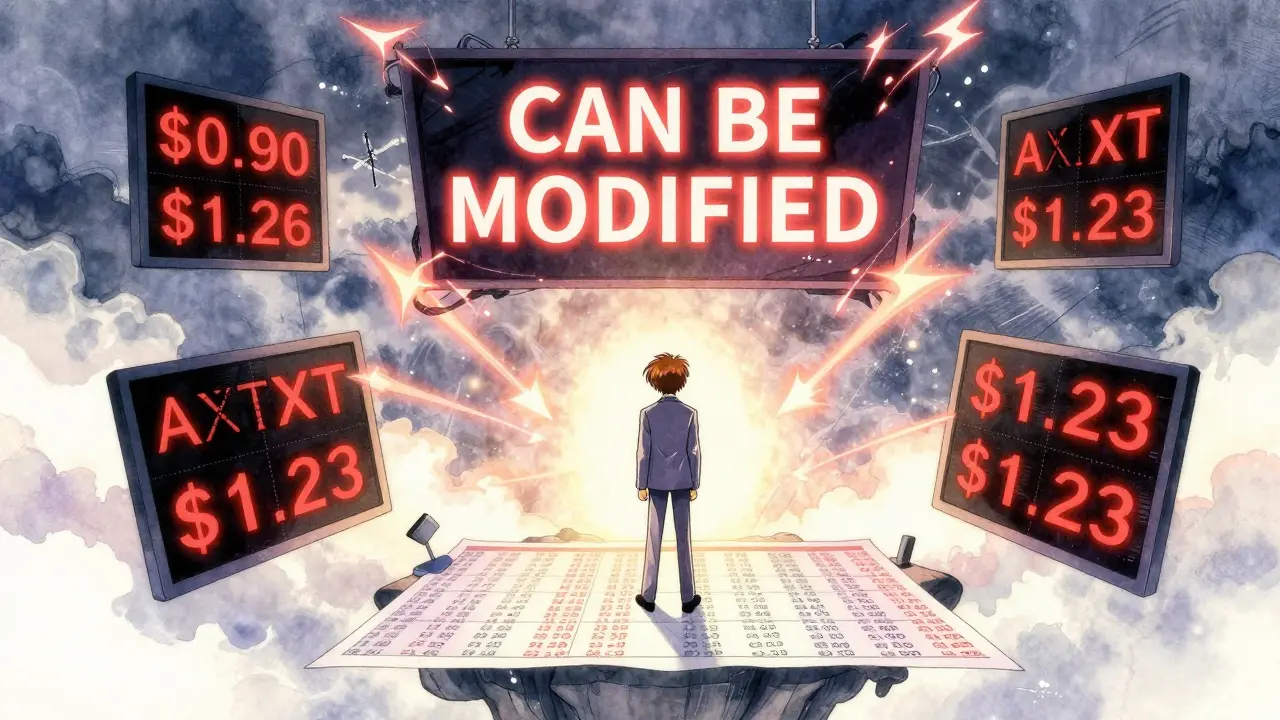
Even worse, price data across exchanges is inconsistent. CoinMarketCap reports $0.91, Binance says $0.90, FXEmpire claims $1.26, and CoinGecko shows $1.23. If the token were genuinely traded, these numbers would align. The fact they don’t suggests trading volume is fabricated or nonexistent. CoinMarketCap itself lists AXT’s 24-hour trading volume as $0-a clear sign that no real buyers are active.
The Smart Contract That Can Be Changed Anytime
This is the most dangerous red flag. CoinMarketCap and Binance both warn users: “The smart contract of the following asset can be modified by the contract creator.” What does that mean? It means the team behind AXT can:
- Disable selling, trapping your tokens forever
- Mint new tokens, diluting your holdings
- Change fees, making transfers impossible
- Transfer tokens out of wallets without consent
This isn’t a bug-it’s a feature. And it’s a feature that has been used in countless scams. Industry analysts like John Walden from CryptoSlate have called this a “critical red flag for scam coins.” If the creators can change the rules after you invest, there’s zero protection for you. You’re not buying an asset-you’re trusting a group of anonymous people who could vanish tomorrow.
No Community, No Transparency, No Future
Legitimate crypto projects build communities. They have active Telegram groups, Reddit threads, Twitter updates, and developer blogs. AXT has none of that. Searches on r/CryptoCurrency, r/Altcoin, and other major forums return zero substantive discussions. Trustpilot, Reddit, and GitHub show no user reviews, no code commits, no support tickets.
According to crypto researcher Sarah Zhang, projects with real utility typically attract at least 1,000 active community members within six months. AXT has 385 holders and almost no discussion. That’s not a quiet launch-it’s a dead project.
Even the wallet service mentioned by Azbit lacks details. There’s no guide on how to buy, store, or use AXT. No step-by-step instructions. No video tutorials. No customer support contacts. If you can’t figure out how to use it, it’s not a product-it’s a gamble.
Why Real Estate Tokenization Doesn’t Apply Here
The real estate tokenization market was worth over $10 billion in 2023 and is projected to hit $16 billion by 2025. But AXT isn’t part of that market. Legitimate players like RealT, Tokenplace, and Brickblock operate with clear legal frameworks, regulatory compliance, and verified property holdings. They publish audits, legal opinions, and property lists. AXT does none of this.
The U.S. Securities and Exchange Commission has already penalized companies like the REcoin Foundation for $30 million for falsely claiming real estate backing. AXT operates with the same lack of transparency-and without any public regulatory filings. If it were real, it would be shut down.
The Future of AXT: A Predictable Collapse
Analysts at CoinCheckup predict AXT will drop another 25% to $0.29 by November 2025. That’s not a forecast-it’s a timeline. The token’s characteristics match a pattern studied by crypto researcher Michael Grunstein: tokens with modifiable smart contracts and inflated market caps have a 92.7% failure rate within 18 months.
There’s no development activity. No roadmap updates. No press releases. No team introductions. The project has been silent since its peak in May 2024. That’s not a pause-it’s an abandonment.
AXT doesn’t just lack utility. It lacks legitimacy. It’s built on hype, not technology. It’s fueled by speculation, not value. And its smart contract gives its creators total control over your money.
Final Verdict: Avoid Axioma Token (AXT)
If you’re looking for exposure to real estate tokenization, there are better options-ones with transparency, legal backing, and active communities. AXT is not one of them.
It’s not a failed project. It was never a real one.
Don’t invest. Don’t trade. Don’t even hold it. The risk isn’t just financial-it’s total loss.
Is Axioma Token (AXT) a scam?
Based on available evidence, AXT exhibits multiple hallmarks of a scam: a modifiable smart contract that allows the creators to freeze funds or mint new tokens, an inflated market cap with fewer than 400 holders, zero verifiable real-world asset backing, inconsistent price data, and no public team or documentation. These are well-documented red flags in crypto analysis. Experts like John Walden and Diogo Costa have linked these traits directly to fraudulent projects. While no official regulatory action has been taken yet, the pattern strongly suggests intentional deception.
Can I trust the price of AXT on exchanges?
No. Price data for AXT varies wildly between platforms-ranging from $0.90 on Binance to $1.26 on FXEmpire. CoinMarketCap reports $0 in 24-hour trading volume despite a $600 million market cap, which is mathematically impossible. This suggests the prices are either fabricated or based on minimal, artificial trading. The lack of consistent volume and conflicting prices indicates the market is not organic-it’s manipulated.
Why does AXT have such a high market cap with so few holders?
A market cap of $600 million with only 385 holders is statistically impossible in a functioning market. Typically, such a high market cap would require tens of thousands of active participants. The only explanation is that a very small number of wallets-possibly even one-control the majority of supply and are artificially inflating the price through coordinated buying. This is a classic sign of a pump-and-dump scheme designed to lure in retail investors before the price collapses.
Does AXT actually back any real estate?
There is zero verifiable evidence that AXT is backed by any real estate. No property lists, no deeds, no legal agreements, no audits, and no third-party verification have been published. In contrast, legitimate real estate tokenization platforms like RealT and Brickblock openly display their property portfolios, ownership structures, and compliance documentation. AXT’s claims are entirely unsubstantiated, making them speculative at best and fraudulent at worst.
What should I do if I already own AXT?
If you own AXT, consider it a high-risk holding with a very low chance of recovery. The smart contract allows the creators to disable selling or dilute your tokens at any time. There is no support, no roadmap, and no active development. The safest course of action is to sell what you can, even at a loss, and move your funds to more transparent assets. Holding AXT longer increases your risk of total loss.