
Privacy Coin Availability Checker
Privacy Coin Availability
Privacy coins are disappearing from crypto exchanges - and it’s not just a trend, it’s a global crackdown.
If you’ve tried to trade Monero, Zcash, or Dash on Binance, Kraken, or Upbit lately, you might’ve noticed they’re gone. Not temporarily down. Not under maintenance. Delisted. Since early 2025, over 73 exchanges worldwide have removed privacy-focused cryptocurrencies from their platforms. That’s a 43% jump from just two years ago. And it’s not random. This is a coordinated, regulator-driven purge - and it’s reshaping how people access cryptocurrency privacy.
Privacy coins were built to hide transaction details. Unlike Bitcoin, where every transfer is publicly visible on the blockchain, privacy coins use advanced cryptography to scramble sender, receiver, and amount. Monero uses ring signatures to mix your transaction with others. Zcash uses zero-knowledge proofs to prove a transaction is valid without showing any data. These aren’t bugs - they’re features. But regulators say those features are dangerous.
Why regulators are targeting privacy coins
The Financial Action Task Force (FATF), the global watchdog for anti-money laundering rules, changed its guidance in June 2024. It now demands that exchanges collect and share customer data for all transactions over $1,000 - the so-called "Travel Rule." That’s fine for Bitcoin. You can trace every wallet address. But privacy coins? They were designed to make that impossible.
Exchanges can’t comply with FATF rules if they list coins that block transaction tracing. So they chose compliance over listing. Binance pulled Monero, Zcash, and Dash from its European and U.S. platforms in February 2025. Kraken followed in March, citing Canada’s FINTRAC rules. Japan’s entire exchange industry stopped supporting privacy coins after the Japan Financial Services Agency doubled down on its 2018 ban. South Korea’s top five exchanges, including Upbit and Bithumb, removed six privacy coins by September 2025, all citing FATF pressure.
The European Union’s MiCA regulation, which took effect in 2025, forced exchanges to cut privacy coin offerings by 22%. Now, 97 countries have tightened AML and CTF rules since 2024. Privacy coins are caught in the crosshairs because they’re the only major crypto category that fundamentally resists identity tracking.
What privacy coins are affected?
The main targets are clear: Monero (XMR), Zcash (ZEC), Dash (DASH), PIVX, Haven (XHV), and BitTube (TUBE). Together, they made up 11.4% of all crypto transactions in 2025 - over $250 billion in volume. Monero alone accounts for nearly 60% of that.
Monero is the most affected because it’s the most private. Its ring signatures and stealth addresses make it nearly impossible to trace. Zcash offers optional privacy (shielded transactions), but even that’s too risky for exchanges under strict regulators. Dash’s PrivateSend feature, while less robust than Monero’s, still scrambles transaction paths - enough to trigger compliance alarms.
Some coins, like PIVX and Haven, were already niche. Their delisting barely made headlines. But when Binance removes Monero - a coin with millions of active users - it sends a signal: if you want to trade on a major exchange, you give up privacy.

Where are privacy coins still available?
Not everywhere. The regulatory landscape is a patchwork.
Japan and South Korea have outright bans. Australia restricts access. The EU plans a full ban on anonymous crypto accounts by July 2027. Dubai joined the list in 2023.
But not all regions are shutting the door. Switzerland and Liechtenstein still allow privacy coins - but only if exchanges enforce strict KYC and AML checks. Singapore permits them with enhanced monitoring. These places are trying to balance innovation with compliance.
And then there’s the underground. Decentralized exchanges (DEXs) like Uniswap and PancakeSwap don’t require KYC. Peer-to-peer platforms like LocalMonero saw a 19% surge in activity after centralized exchanges pulled privacy coins. Users are migrating to atomic swaps, non-custodial wallets, and crypto ATMs that don’t ask for ID. The privacy coin community isn’t giving up - it’s just going dark.
Market impact: Prices are rising despite the ban
Here’s the twist: even as exchanges delist privacy coins, their prices are climbing. In 2025, privacy coins as a group gained 71.6% - outpacing Bitcoin. Why?
Supply is shrinking on major platforms. Fewer exchanges mean fewer buyers. That scarcity drives up demand among those who still want access. Institutional investors are quietly accumulating Monero and Zcash, betting that regulatory pressure will eventually ease - or that privacy will remain valuable enough to justify the risk.
Zcash saw an 8% drop in shielded transactions due to KYC restrictions, proving regulators can slow adoption. But overall, the market says: people still want privacy. The fact that these coins are harder to buy might be making them more desirable.
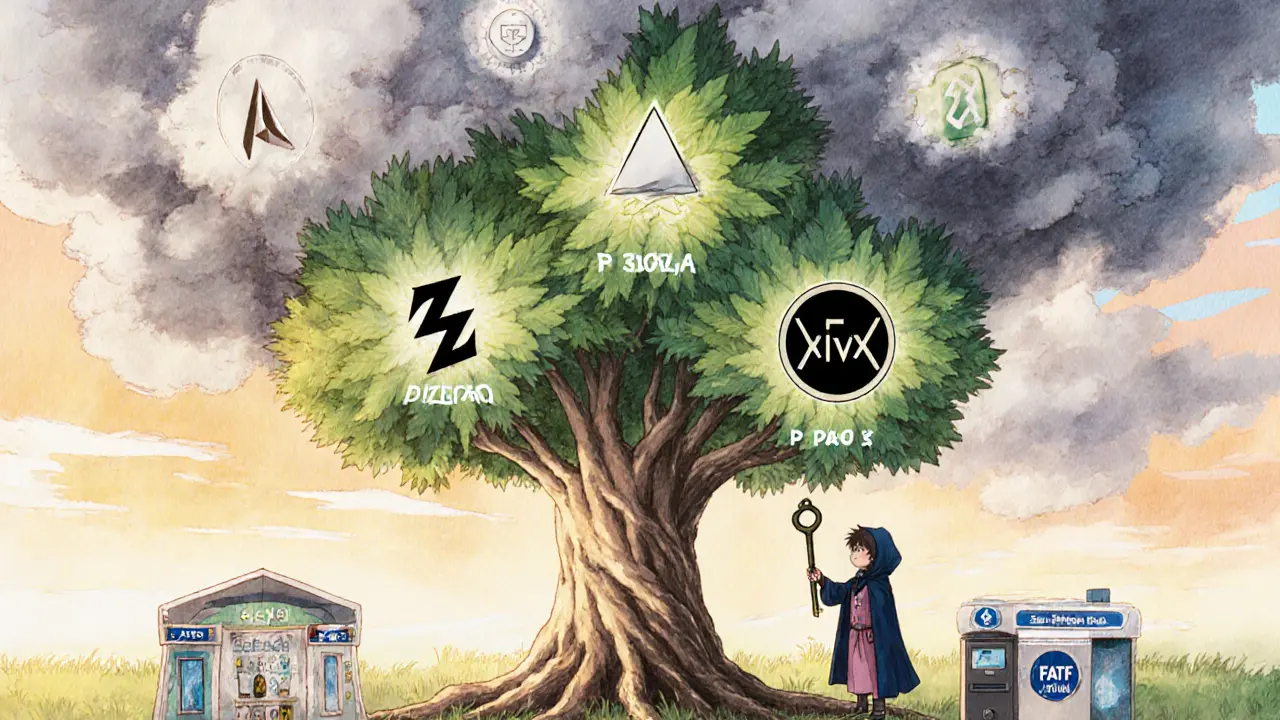
What does this mean for users?
If you’re a casual trader who just wanted to buy a little Monero on Coinbase - you’re out of luck. The easy path is gone.
Now, you need to work harder. You’ll need a non-custodial wallet (like Monero GUI or Cake Wallet). You’ll need to use a DEX or P2P platform. You’ll need to understand how to do atomic swaps or use Tor to protect your IP. It’s no longer just about clicking "Buy." It’s about privacy literacy.
Some users accept this. They say: if crypto wants to be mainstream, it must play by the rules. Others feel betrayed. They argue that financial privacy is a human right - not a loophole to be patched. In authoritarian countries, privacy coins help people protect savings from state surveillance. In the U.S., they shield business transactions from competitors. These aren’t just criminal use cases - they’re legitimate, everyday needs.
The future: Can privacy coins survive?
Privacy coin developers aren’t sitting still. Teams behind Monero and Zcash are working on "compliant privacy" - new protocols that can prove a transaction is legal without revealing details. Imagine a zero-knowledge proof that says: "This transaction isn’t linked to a sanctioned wallet," without showing who sent it.
Industry analysts say 74% of privacy coin developers now see FATF rules as their biggest challenge. The goal isn’t to fight regulation - it’s to out-engineer it. If they succeed, we might see a new generation of privacy coins that regulators can’t ban - because they can’t even detect them.
But if they fail? Privacy coins will become niche tools - used only by the technically savvy, the distrustful, or the desperate. And that’s a dangerous path. When privacy becomes a privilege only available off the grid, it stops being a right - and starts being a risk.
What’s next?
Expect more delistings. More regulatory pressure. More user migration to decentralized platforms. And more innovation - because the demand for privacy isn’t going away.
Exchanges will keep choosing compliance. Users will keep choosing privacy. The middle ground? Still being built.
Why are privacy coins being delisted from exchanges?
Privacy coins are being delisted because they make it technically impossible for exchanges to comply with global anti-money laundering (AML) and counter-terrorism financing (CTF) rules. Regulations like the FATF Travel Rule require exchanges to track the origin and destination of funds above $1,000. Privacy coins like Monero and Zcash use encryption to hide transaction details, making compliance unfeasible. Exchanges choose to remove them to avoid fines, license revocations, or legal action.
Which exchanges have delisted privacy coins?
Major exchanges including Binance, Kraken, OKEx Korea, Upbit, and Bithumb have delisted privacy coins like Monero, Zcash, and Dash since early 2025. Japan’s entire exchange industry stopped supporting them in 2025 following guidance from the Japan Financial Services Agency. Kraken removed them from its Canadian platform due to FINTRAC rules. Over 73 exchanges globally have taken similar action.
Are privacy coins completely banned?
No - not everywhere. Japan and South Korea have outright bans. The EU plans a full ban by 2027. But in Switzerland, Liechtenstein, and Singapore, privacy coins are still available under strict KYC and AML rules. The U.S. hasn’t banned them outright, but federal pressure (like from the Treasury Department) has pushed exchanges to delist them voluntarily.
Can I still buy Monero or Zcash?
Yes, but not on major centralized exchanges. You can still buy them on decentralized exchanges (DEXs) like Uniswap, or peer-to-peer platforms like LocalMonero. You’ll need a non-custodial wallet and may need to use Tor or a VPN to protect your identity. Atomic swaps also allow direct, private trades between users without intermediaries.
Why are privacy coin prices rising if they’re being delisted?
Delistings reduce supply on major platforms, creating scarcity. Demand hasn’t dropped - it’s just moved. Institutional investors and long-term holders are accumulating privacy coins, betting that their value lies in privacy itself. In 2025, privacy coins gained 71.6% despite regulatory headwinds, outperforming Bitcoin. Less liquidity on exchanges doesn’t mean less interest - it means the market is becoming more decentralized.
Is there a future for privacy coins?
Yes - but only if they evolve. Developers are working on "compliant privacy" technologies - like zero-knowledge proofs that prove a transaction is legal without revealing data. If they succeed, privacy coins could meet regulatory standards without sacrificing anonymity. If they don’t, privacy coins will become tools for the underground, losing mainstream relevance. The next five years will determine whether privacy survives as a feature - or becomes a relic.